Setting the National Standard for NSF 61 Certified Gasket Cutting
When it comes to drinking water safety, not all gasket manufacturers are created equal. Materials that come into contact with potable water must meet strict health based requirements to ensure they do not leach harmful contaminants into the water supply. This is where NSF ANSI CAN 61 certification becomes critical.
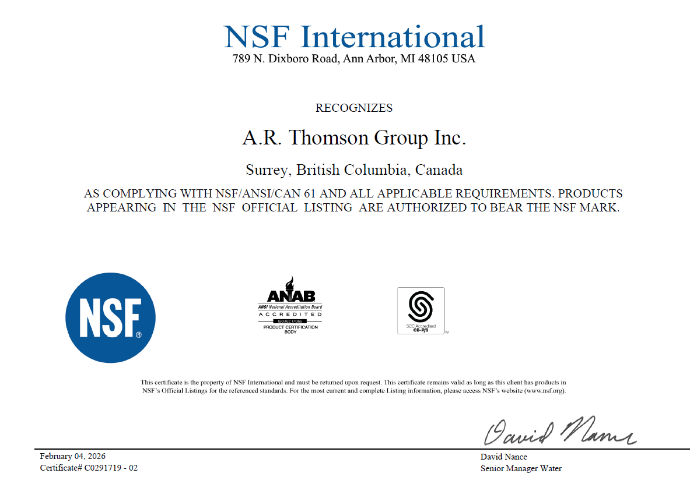
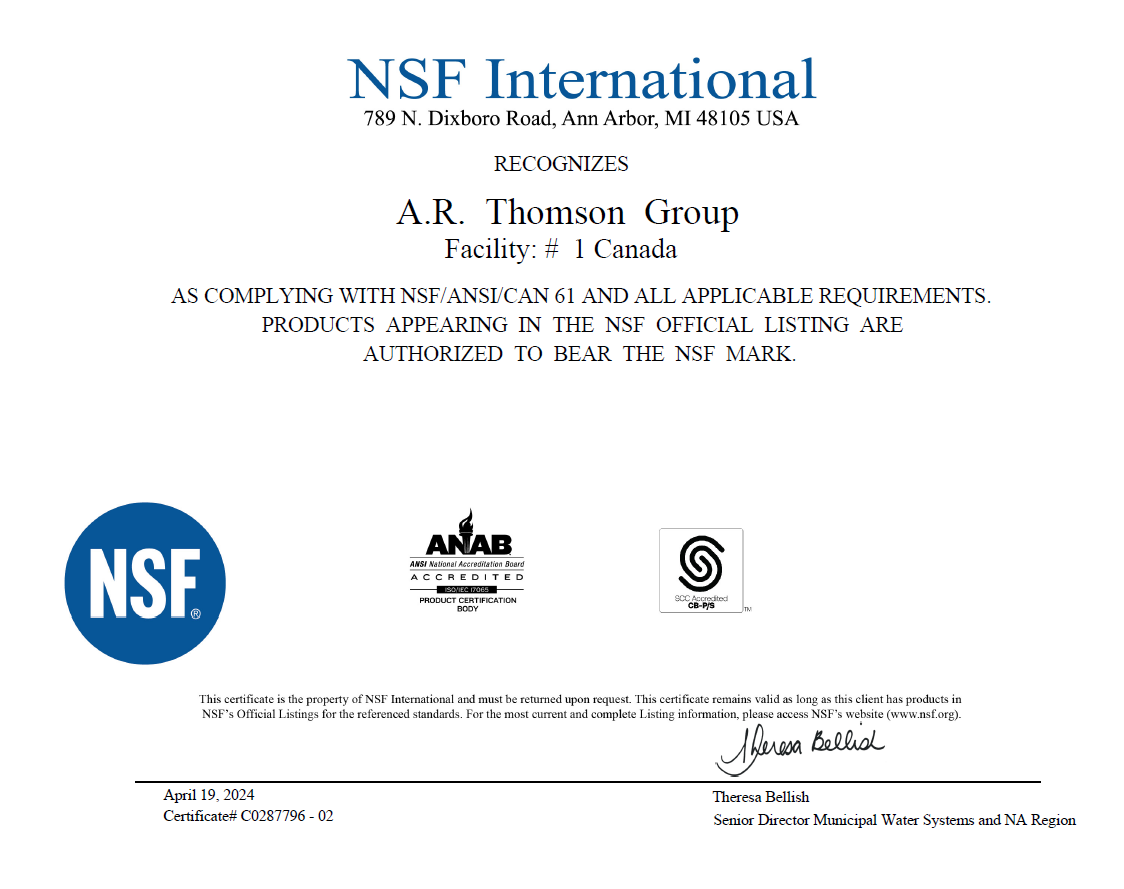
AR Thomson Surrey stands apart as the #1 gasket cutting facility in Canada that has undergone NSF 61 auditing for its gasket manufacturing processes. This distinction matters to municipalities, engineers, and water system operators who require the highest level of documented compliance and third party oversight for components used in potable water applications.
What NSF ANSI CAN 61 Certification Means
NSF ANSI CAN 61 is a public consensus standard that establishes minimum health effects criteria for materials, components, and products that come into contact with drinking water. The standard evaluates whether chemical contaminants or impurities can leach from a product into potable water at levels that could pose a risk to human health. [nsf.org]
Gaskets fall under the standard’s scope as joining and sealing materials, making proper formulation control, handling, and manufacturing conditions essential for compliance. [nsf.org]
The Rigorous Path to NSF 61 Certification
Certification to NSF ANSI CAN 61 is not a single test or a paperwork exercise. According to NSF, the pathway to certification follows a structured seven step process designed to verify both product safety and manufacturing integrity. [nsf.org]
Application and Product Disclosure
The manufacturer submits a formal application and provides detailed product information, including formulation, toxicology data, and intended use in drinking water systems. This ensures full transparency before any testing begins. [nsf.org]
Technical Review
NSF technical experts review submitted formulations and component lists to determine which tests are required under the standard. This review confirms that materials fall within the scope of NSF ANSI CAN 61 and identifies applicable test protocols. [nsf.org]
On Site Audit of the Manufacturing Facility
An on site audit is conducted at the production facility. During this audit, NSF evaluates manufacturing controls, material traceability, quality systems, and handling procedures. Product samples are collected or requested directly from the audited facility, tying certification to the actual production environment. [nsf.org]
Laboratory Testing
NSF laboratories perform extraction testing on the product to measure potential chemical leaching into drinking water. These results are compared against strict health based acceptance criteria defined by the standard. [nsf.org]
Technical Evaluation and Certification
Testing results and audit findings are reviewed together to confirm compliance. Only after meeting all requirements is NSF ANSI CAN 61 certification granted. Certification is maintained through ongoing annual audits and compliance reviews. [nsf.org]
Certification Requirements Can Vary
It is important to note that not all claims of NSF 61 compliance carry the same weight. NSF explicitly states that requirements for testing or certification can vary in rigorousness, ranging from full third party certification by an accredited certification body to basic market acceptance or customer specification. [nsf.org]
This distinction is critical. Full third party certification with on site auditing provides a significantly higher level of assurance than material level testing alone.
Why AR Thomson Surrey’s Certification Matters
By undergoing NSF auditing at its Surrey facility, AR Thomson demonstrates that its gasket cutting processes, quality controls, and material handling meet the same rigorous standards applied to certified drinking water system components.
For customers in municipal water, wastewater, and industrial potable water applications, this means greater confidence that gaskets supplied from AR Thomson Surrey are produced under verified conditions aligned with NSF ANSI CAN 61 requirements.
In an industry where compliance, traceability, and public health protection are non negotiable, AR Thomson Surrey’s audited status represents a meaningful competitive and technical advantage.
Setting the Bar for Gasket Cutting in Canada
NSF ANSI CAN 61 certification is widely recognized across North America as the benchmark for drinking water safety. By aligning its gasket cutting operations with this standard, AR Thomson Surrey continues to raise expectations for quality, transparency, and accountability within the Canadian sealing industry.
For organizations that cannot afford uncertainty in potable water systems, working with an NSF audited gasket cutting facility is not just a preference. It is a necessity.